
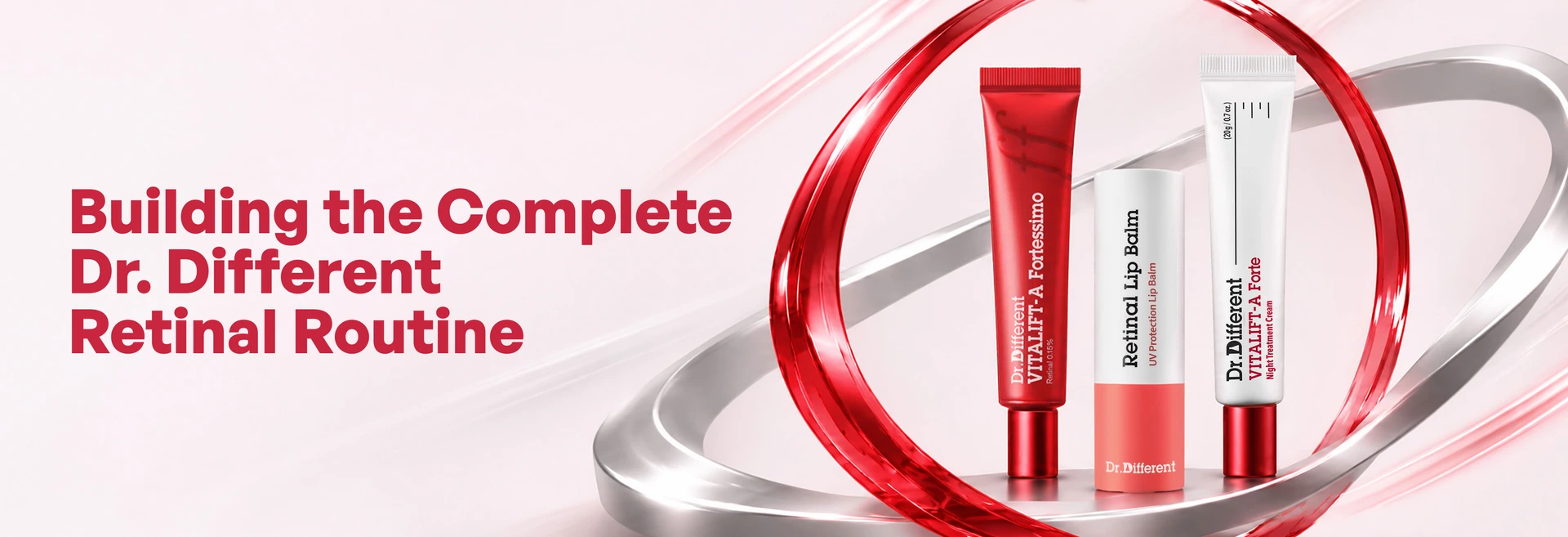
Three products. Distinct roles. No need to use everything at once.
A complete routine is not the same as a crowded one. With retinal, knowing when to hold back matters just as much as knowing what to apply.
Dr. Different’s Forte 0.1%, Fortessimo 0.15% and Retinal Lip Balm Tinted can be understood as two alternative facial strengths and one separate lip-care option. The idea is progression where it makes sense, targeted care where it belongs, and recovery time throughout.
Here is how to put those roles into a routine without turning your bathroom shelf into a nightly endurance test.
Forte 0.1%: the lower-strength facial starting point
VITALIFT-A Forte Retinal 0.1%, 20g is the lower-strength cream in this pairing. Its night-treatment positioning centres on concerns such as visible fine lines, tone and texture, with listed ingredients including squalane, ceramide NP and sodium hyaluronate to support moisture.
Consider it before Fortessimo when choosing between these two strengths. That is not the same as calling it universally beginner-friendly: people new to retinoids or prone to irritation may need a lower concentration or professional guidance. Introduce it cautiously, follow the label and judge the routine by your skin’s comfort—not by how quickly you can increase use.
Fortessimo 0.15%: an optional progression for experienced users
VITALIFT-A Fortessimo Retinal 0.15%, 30g is the more intensive facial option, described for experienced retinal users. Its formula combines retinal with squalane, ceramide NP and supporting lipids, with a focus on the appearance of wrinkles, firmness and texture.
The progression is Forte → Fortessimo only if your skin tolerates the existing routine and a stronger option makes sense for you. It is not a fixed timetable or a requirement. When switching, avoid increasing frequency at the same time. Choose one facial retinal cream per treatment night; these two are alternatives, not consecutive layers.
Retinal Lip Balm Tinted: a separate step for the lips
Retinal Lip Balm Tinted, 4g gives lip care its own place in the lineup, combining moisturising care with a tinted finish. It complements the facial routine without asking you to take a face cream onto a delicate area where it does not belong.
Introduce it separately and use it only as directed and tolerated. Its place can continue across either facial-strength stage, but that does not mean it must be used every night. If your lips become irritated, pause the active balm and keep care simple. Use a dedicated broad-spectrum SPF 30 or higher lip product for daytime protection.
A recovery-first approach to skin cycling
Skin cycling is a way to organise treatment and recovery evenings—not a rule that everyone needs frequent exfoliation. For this retinal-focused routine, keep the structure simple and flexible:
- Treatment evening: gentle cleansing, one appropriate facial retinal cream used according to its label, and moisturiser.
- Recovery evenings: gentle cleansing and moisturiser, without facial retinal or exfoliating acids. Give your skin enough time to feel comfortable before another treatment night.
- Lip care: follow the lip balm’s separate directions and your lips’ response. On an irritation-recovery night, choose a simple non-active balm instead.
- Every morning: moisturiser as needed, broad-spectrum SPF 30 or higher, and appropriate lip sun protection.
The number of recovery nights is personal. More is reasonable if your skin needs it. Do not treat burning or persistent peeling as proof that the routine is working.
Shop the Dr. Different Collection
Choose the role your routine needs rather than assuming you need every product immediately.
- VITALIFT-A Forte Retinal 0.1%, 20g — the lower-strength facial option in this pair.
- VITALIFT-A Fortessimo Retinal 0.15%, 30g — the intensive option for experienced retinal users.
- Retinal Lip Balm Tinted, 4g — moisturising lip care with a tinted finish.
The verdict
The complete Dr. Different routine is not three products piled on at bedtime. It is the right facial strength, a separate approach to lips, and enough recovery and sun protection to make the routine sustainable.
Start where your skin is comfortable. Move forward only if there is a good reason. Sometimes the smartest next step is simply staying consistent.
Safety note: Avoid retinoids during pregnancy or when trying to conceive. If breastfeeding or using prescription skin treatments, ask your clinician before use.