
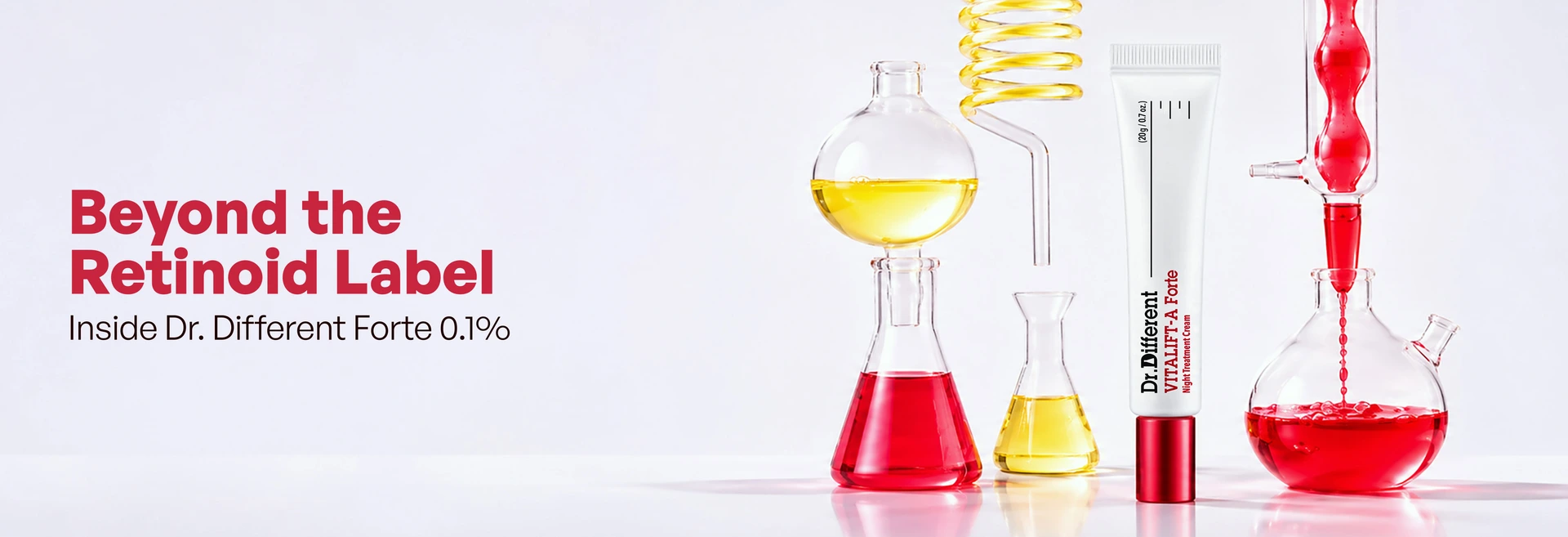
The ingredient name is only the beginning
A retinoid label can make shopping feel like an exercise in comparing numbers. But once you have chosen the ingredient family, there is another decision to make: which finished formula belongs on your shelf?
Here, we take a closer look at one specific cream: Dr. Different VITALIFT-A Forte Retinal 0.1%.
The focus here is the formula around the active, what its label can tell you, and how to decide whether it deserves a place in an established evening routine.
Meet Forte: a retinal treatment in a cream format
Dr. Different VITALIFT-A Forte Retinal 0.1%, 20g is a night-treatment cream containing 0.1% retinal. It is designed for concerns including the appearance of fine lines, uneven tone, texture and loss of firmness.
That gives you two useful pieces of information: the active and its stated concentration. The cream format adds a third consideration. Rather than choosing an active in isolation, you are choosing a treatment that also brings moisturising ingredients into that evening step.
It is worth reading those ingredients with as much attention as the percentage on the front.
The supporting cast deserves a closer look
Forte’s supporting ingredients include squalane, ceramide NP, sodium hyaluronate and tocopherol. Each has a different role in the formula:
- Squalane is an emollient that helps soften skin and supports a moisturised feel.
- Ceramide NP is a skin-identical lipid commonly used in formulas intended to support the moisture barrier.
- Sodium hyaluronate, a form of hyaluronic acid, is a humectant that helps attract and retain moisture.
- Tocopherol, a form of vitamin E, is used in skincare for its antioxidant and skin-conditioning properties.
Together, these ingredients explain why a retinal cream is more than its headline active. Moisture and skin comfort matter when choosing a treatment you intend to use consistently. Your separate moisturiser can still have a place; a moisturising treatment and a complete routine are not the same thing.
What the 0.1% tells you—and what else to consider
The concentration identifies the retinal level in this product. It is not a universal score for how a cream will feel on your skin; the finished formula and your individual tolerance also matter.
Before choosing Forte, ask three more practical questions:
- How does your current treatment feel? Comfortable, settled skin gives you a more useful starting point than a calendar-based deadline to change products.
- What are you hoping to improve? Keep the focus on a specific concern, such as the appearance of fine lines or uneven texture, rather than buying a percentage for its own sake.
- Will you change only one variable? Keeping your familiar cleanser, moisturiser and sunscreen makes it easier to understand your response to a new treatment.
Forte is the lower-concentration cream compared with Dr. Different Fortessimo 0.15%, but 0.1% retinal is not automatically an entry-level choice for someone completely new to retinoids. If you are new or easily irritated, consider a lower-strength starting point or ask a qualified professional for guidance.
Give a considered formula a considered introduction
Follow the product’s packaging directions, introduce it cautiously on spaced-out evenings and avoid adding new exfoliating acids or scrubs at the same time. Do not layer it with another facial retinoid to increase the effect. Keep the facial cream away from the lips and eyelids.
Persistent burning, redness or peeling is a reason to pause and reassess. Daily broad-spectrum SPF 30 or higher remains part of the morning routine.
The takeaway: choose the whole formula
Forte combines retinal with emollient, humectant and barrier-supporting ingredients in a cream. That whole-formula perspective is more useful than judging a treatment by its active concentration alone.
If you are considering it, look at your current tolerance, your skin goals and the surrounding routine—not just the number on the tube. Explore Forte through the product link above, and let a comfortable, consistent routine matter more than a stronger-sounding label.
Safety note: Avoid retinoids during pregnancy or when trying to conceive. If breastfeeding or using prescription skin treatments, ask your clinician before use.